AutoBatch detects, diagnoses, decides, and remediates across your overnight workload — autonomously, with full audit trail and four-layer safety controls. The AI moat your operations team has been quietly asking for.
Closed-Loop AI
Self-Healing Batch
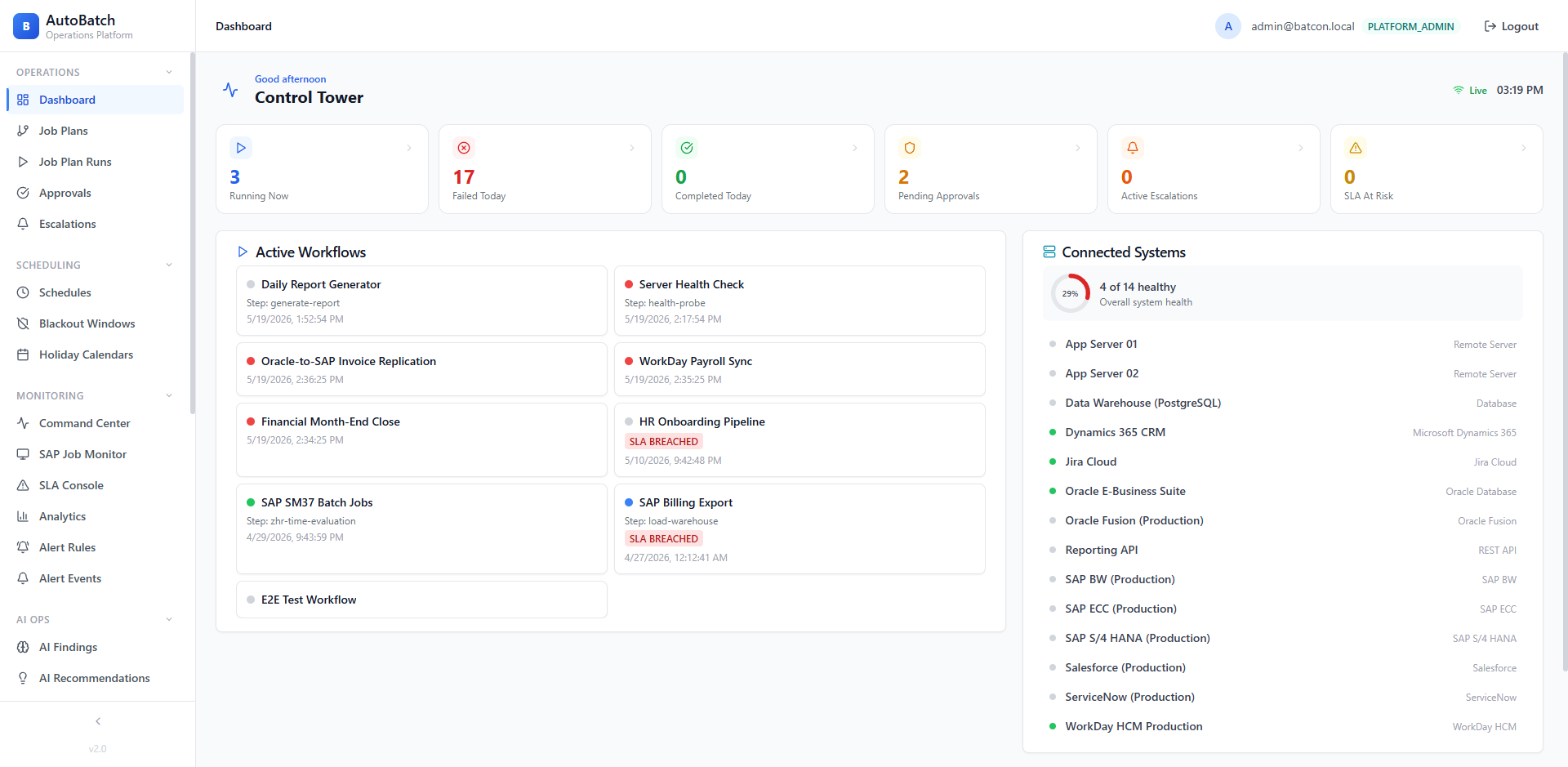
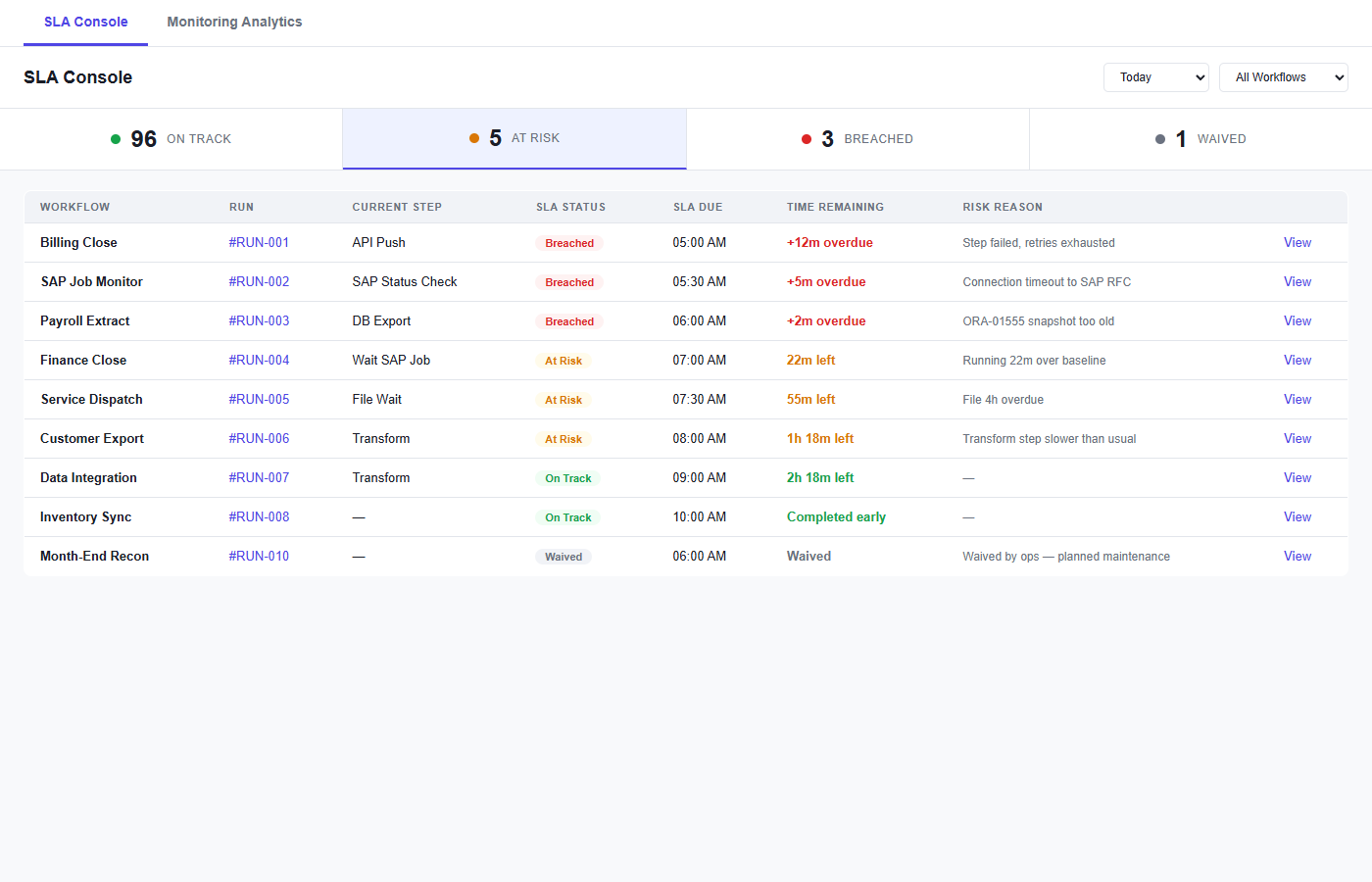
Active workflows, connected systems, escalations, and SLA risk — visible at a glance, updated live.
Anomaly detectors out of the box
Closed loop from detection to learning
AI decisions logged with cited evidence
Sales is automated. Service is automated. Marketing is automated. But the batch jobs that run the business overnight still page a human at 3 AM. AutoBatch closes that loop — detection, diagnosis, decision, remediation — without waking anyone.
Every detected anomaly traces through the same deterministic path. No bespoke runbooks per workflow.
14 anomaly detectors continuously watch run-duration, SLA risk, error spikes, drift, queue saturation and throughput regression — all configurable per tenant.
An LLM authors a root-cause explanation with cited evidence — what changed, which upstream signal predicted it, and which historical patterns it matches.
The decision engine ranks candidate actions by outcome history, confidence and trust score. Low-confidence calls route to a human; high-confidence calls execute immediately.
Action handlers execute the chosen remedy — retry with delay, skip, escalate, run a connector workflow, or page on-call. Every command is policy-checked before dispatch.
A watchdog observes the post-action state and confirms the failure cleared. Bad outcomes auto-escalate to the next contact in the runbook; good outcomes are recorded as evidence.
Outcomes feed back into the action-recommendation model and the trust score. Every incident makes the next decision sharper — the platform's defensible moat compounds with use.
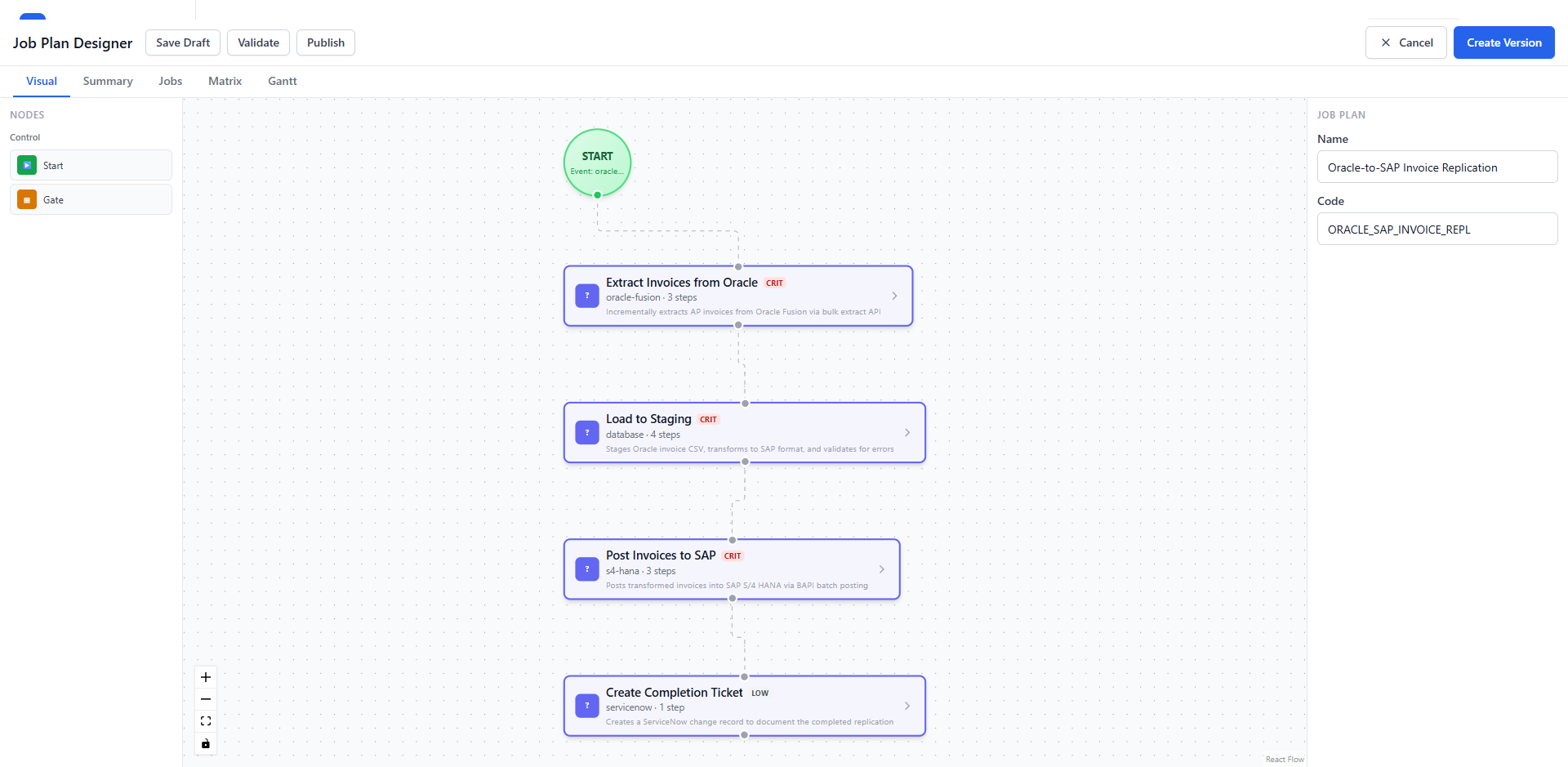
Drag-and-drop tasks, decisions, gates and fan-out steps onto a versioned canvas. The same diagram your operations team designs is the artifact the orchestrator executes — no hidden YAML, no second source of truth.
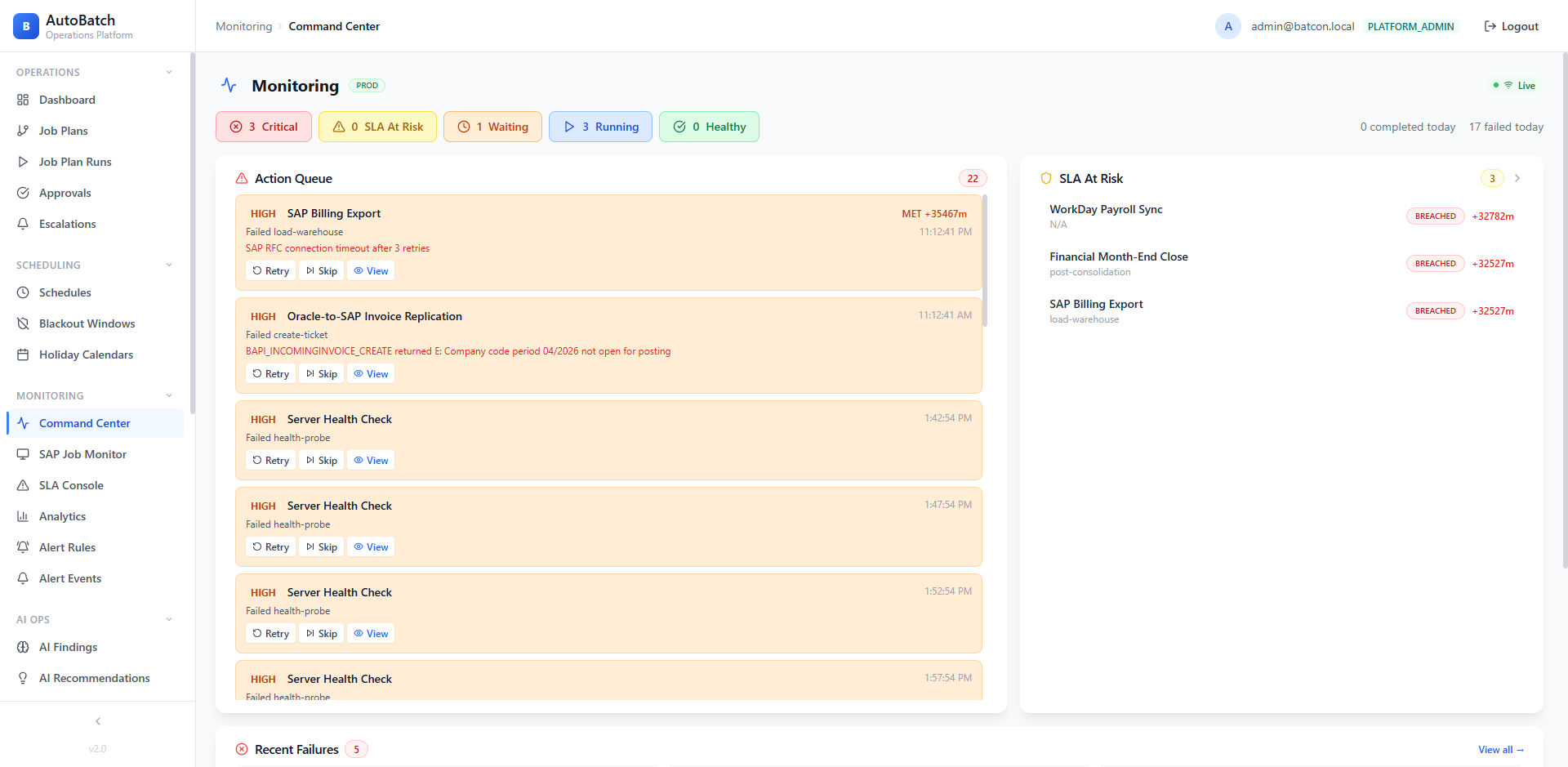
Failures land in the Command Center action queue. Every failed step opens a contextual runbook with the right contacts, the right SLA, and the AI-recommended remedy. No swivel-chair to a wiki.
Action Queue aggregates every failed step, breached SLA, and stuck approval across every active workflow. Operators triage from one queue — not seven tools.
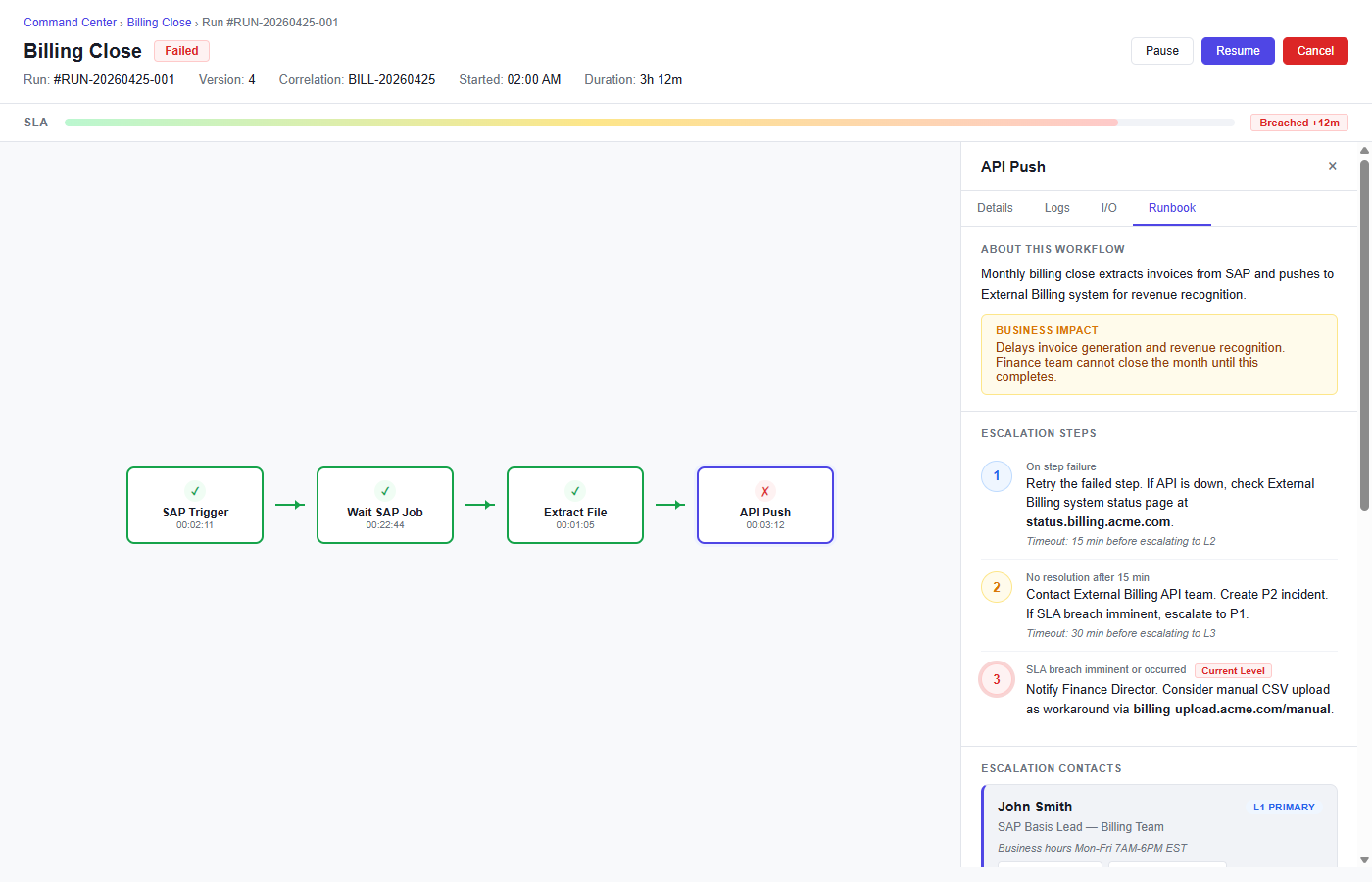
Per-step Runbook ships with the workflow. Business impact, escalation tiers with timeouts, and named contacts — all rendered next to the failure, not buried in Confluence.
The longer AutoBatch runs, the more accurate every finding becomes. Outcome feedback compounds.
One unified signal model. Z-scores, SLA-risk projection, drift detection, co-occurring failures, queue saturation, calendar-aware seasonal baselines — all tunable via typed admin UI, not raw JSON.
Every finding carries an LLM-authored explanation with cited evidence — the upstream signal, the historical pattern, the candidate action that performed best last time. Every reasoning step logged for audit.
Kill-switch (global stop), suspension (per-action throttle), watchdog (post-execution validation) and trust gate (confidence + history threshold). Every action records an outcome; bad outcomes auto-escalate.
Cross-workflow co-occurring failures, time-of-day spike detection, calendar-aware baselines. Outcome feedback turns every incident into training data for the next one.
Drag-and-drop tasks, decisions and fan-out steps. Versioned, validated, and round-tripped to JSON. The same canvas your operations team uses is what the orchestrator executes.
Connectors for the schedulers, queues and ITSM you already run. AutoBatch sits beside your batch infrastructure — it doesn't replace it.
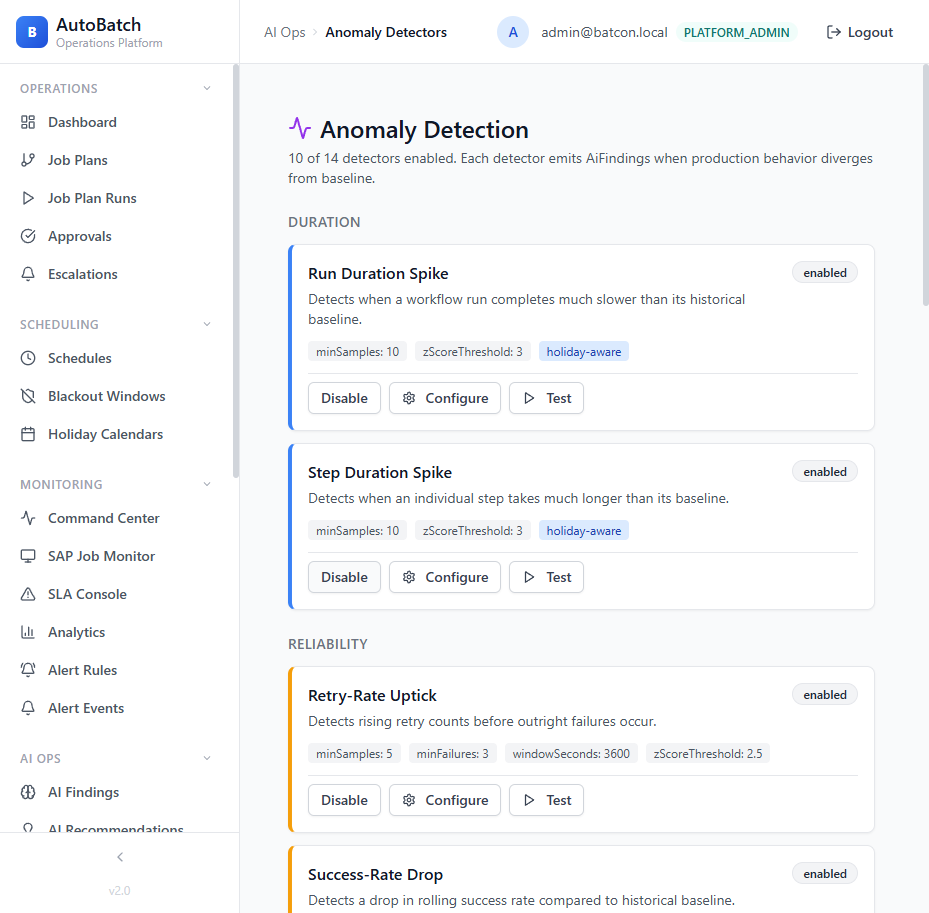
Every detector emits a typed AiFinding when production diverges from baseline. No raw JSON — admins tune thresholds and windows in a typed UI.
Run-duration spike, step-duration spike, throughput regression
Retry-rate uptick, success-rate drop, co-occurring failures
SLA breach projection, time-of-day spike, calendar-aware baseline
Queue saturation, schema drift, connector latency, output-shape drift
Each detector exposes minSamples, zScoreThreshold, and holiday-aware windows. Test against historical runs before enabling — no surprises in production.
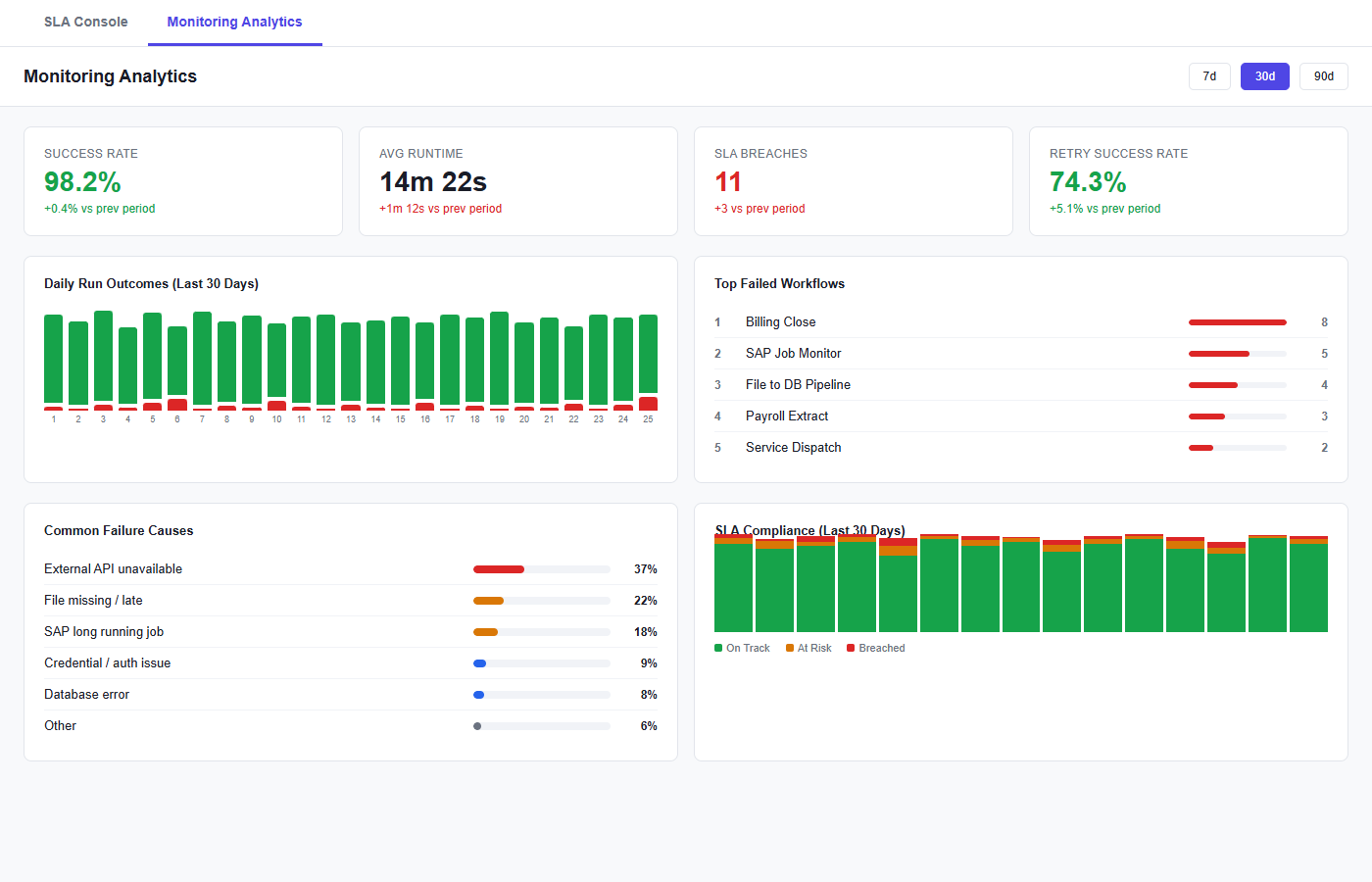
Success rate, retry-success rate, SLA breaches, top failing workflows, and the distribution of root-cause categories — all computed from the same outcome ledger the AI learns from.
Within SLA budget and trending green
Projected breach inside the window — AI proposes mitigation
Past due. Escalation contacts already notified, recovery in flight
AutoBatch is the brain on top of the schedulers, queues, ITSM and ERPs you already run. Drop in a CloudAgent on-prem, connect your systems, and the loop starts closing on day one.
Agentless polling for SAP, Oracle, file servers and REST APIs. CloudAgent for on-prem and air-gapped systems. Webhook intake for push-based signals.
Temporal-backed orchestrator + anomaly detectors + LLM root-cause + policy engine. Multi-tenant by construction; every read and write tenant-scoped via a Prisma extension.
Connector packs execute the chosen remedy. HMAC-signed webhooks, retried delivery, and an immutable outcome ledger — every action recorded against an identity for audit.
Per-tenant Prisma extension; every read and write is tenant-scoped.
Granular roles from Admin to L1 to IT-Support. Every action and AI decision recorded against an identity.
OIDC + SAML, designed for Okta, Azure AD, and Auth0 from day one.
Immutable record of every detection, decision, action and outcome. SOC2-ready.
See how AutoBatch turns the overnight batch from a 3 AM pager problem into a self-healing system.